

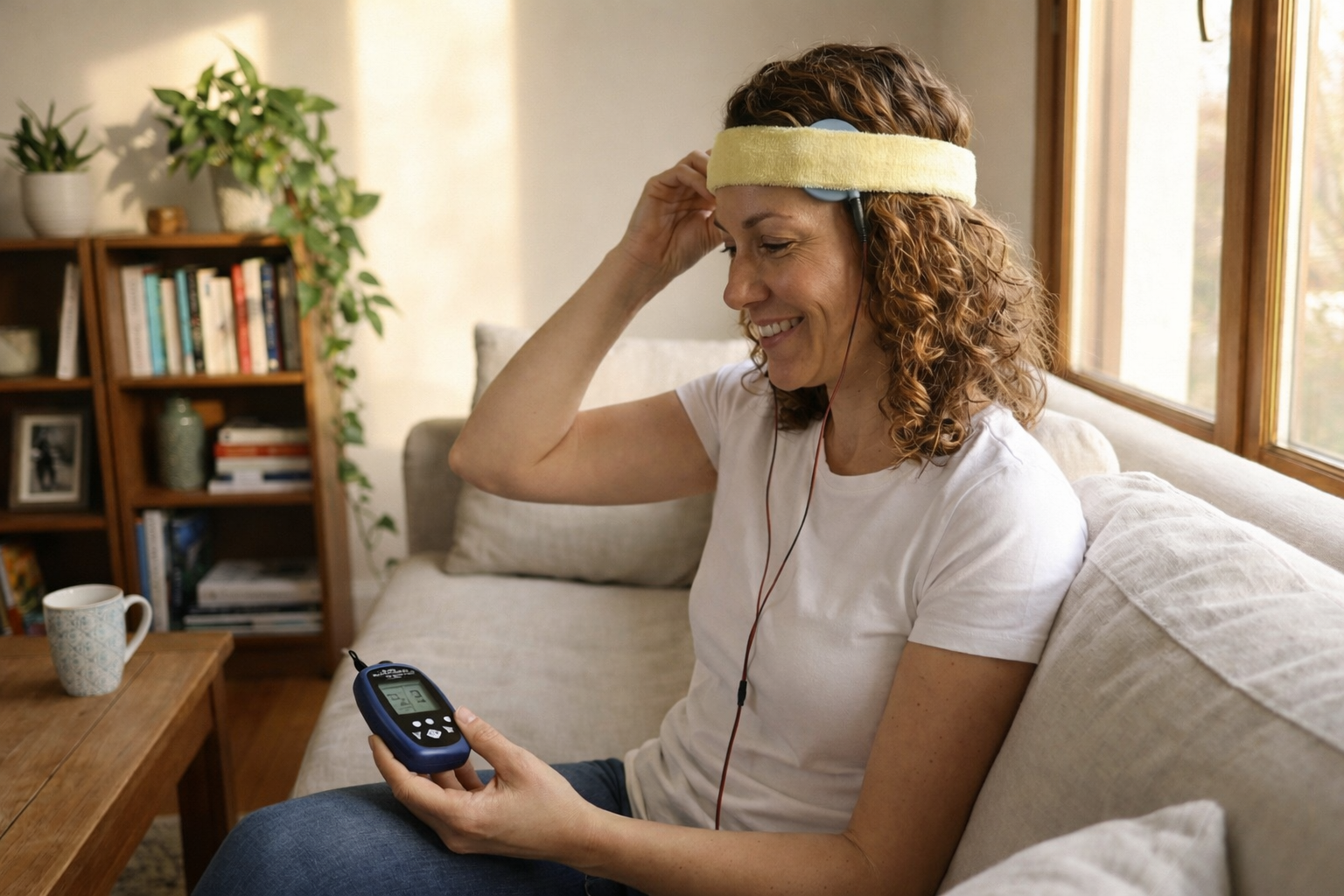
tDCS Placement Montage Maps, Studies
See Brain Maps below that indicate where the Tdcs Electrodes were placed in independent studies. These are known as “Montages”.
| Target Behavior / Uses | Anode (+) Placement | Cathode (−) Placement | Study |
|---|---|---|---|
| Decreased depression / increased organization / improved mood | DLPFC (FP1) | DLPFC (OZ, CZ) | D. Martin; C. Loo (2014) |
| Decreased depression / reduced food & alcohol craving | DLPFC (F3) | Right shoulder | Fregni (2007); Boggio (2007) |
| Improved mood / enhanced cognitive control | DLPFC (F3) | Supraorbital (Fp2) | Vanderhasselt et al. (2013) |
| Reduce risk taking | DLPFC (F4) | DLPFC (F3) | Fecteau et al. (2007) |
| Increased impulsiveness / present awareness | Mastoid (P10) | DLPFC (F4) | Beeli et al. (2008) ; Ledoux (1996) |
| Improved social interaction / reduced punishment of unfair behavior | Left orbital (Fp1) | DLPFC (F4) | Knoch et al. (2008) |
| Attention improvement / working-memory improvement | Orbital PFC (Fp1 & Fp2) | Shoulder | Gladwin et al. (2012) |
| Insight improvement / cognitive enhancement | Temporal (T4) | Temporal (T3) | Chi & Snider (2011) |
| Improved socialization / empathy / emotional regulation | Temporal (T4 & T6), Parietal (P4) | Shoulder | Hétu (2010) |
| Improved motor-skills recovery / motor learning | Ipsilesional (C3) | Orbital (Fp1 or Fp2) | Lindenberg (2010) |
| Theta-tDCS / improved sleep | DLPFC (F3 & F4) | Mastoid (P10 & P9) | Marshall & Kirov (2011) |
Frequently Asked Questions
What is tDCS placement montage guide and how can it help users?
tDCS placement montage guide is a comprehensive reference resource on TheBrainDriver that guides users in correctly positioning tDCS electrodes on the scalp for targeted brain stimulation. Proper montage selection directly supports specific performance benefits: cognitive performance and learning performance (F3/F4 prefrontal montages), memory performance (temporal lobe placements), sports performance and motor skill performance (motor cortex M1 montages), and creative performance and writers performance (right hemisphere stimulation protocols). Choosing the right montage maximizes the effectiveness of every tDCS session.
What is Best tDCS electrode placement montages and how can it help users?
Best tDCS electrode placement montages is a comprehensive reference resource on TheBrainDriver that guides users in correctly positioning tDCS electrodes on the scalp for targeted brain stimulation. Proper montage selection directly supports specific performance benefits: cognitive performance and learning performance (F3/F4 prefrontal montages), memory performance (temporal lobe placements), sports performance and motor skill performance (motor cortex M1 montages), and creative performance and writers performance (right hemisphere stimulation protocols). Choosing the right montage maximizes the effectiveness of every tDCS session.
What is tDCS montage setup resources and how can it help users?
tDCS montage setup resources is a comprehensive reference resource on TheBrainDriver that guides users in correctly positioning tDCS electrodes on the scalp for targeted brain stimulation. Proper montage selection directly supports specific performance benefits: cognitive performance and learning performance (F3/F4 prefrontal montages), memory performance (temporal lobe placements), sports performance and motor skill performance (motor cortex M1 montages), and creative performance and writers performance (right hemisphere stimulation protocols). Choosing the right montage maximizes the effectiveness of every tDCS session.
What is tDCS montage maps and studies and how can it help users?
tDCS montage maps and studies is a comprehensive reference resource on TheBrainDriver that guides users in correctly positioning tDCS electrodes on the scalp for targeted brain stimulation. Proper montage selection directly supports specific performance benefits: cognitive performance and learning performance (F3/F4 prefrontal montages), memory performance (temporal lobe placements), sports performance and motor skill performance (motor cortex M1 montages), and creative performance and writers performance (right hemisphere stimulation protocols). Choosing the right montage maximizes the effectiveness of every tDCS session.
The 10-20 International System of Electrode Placement
-
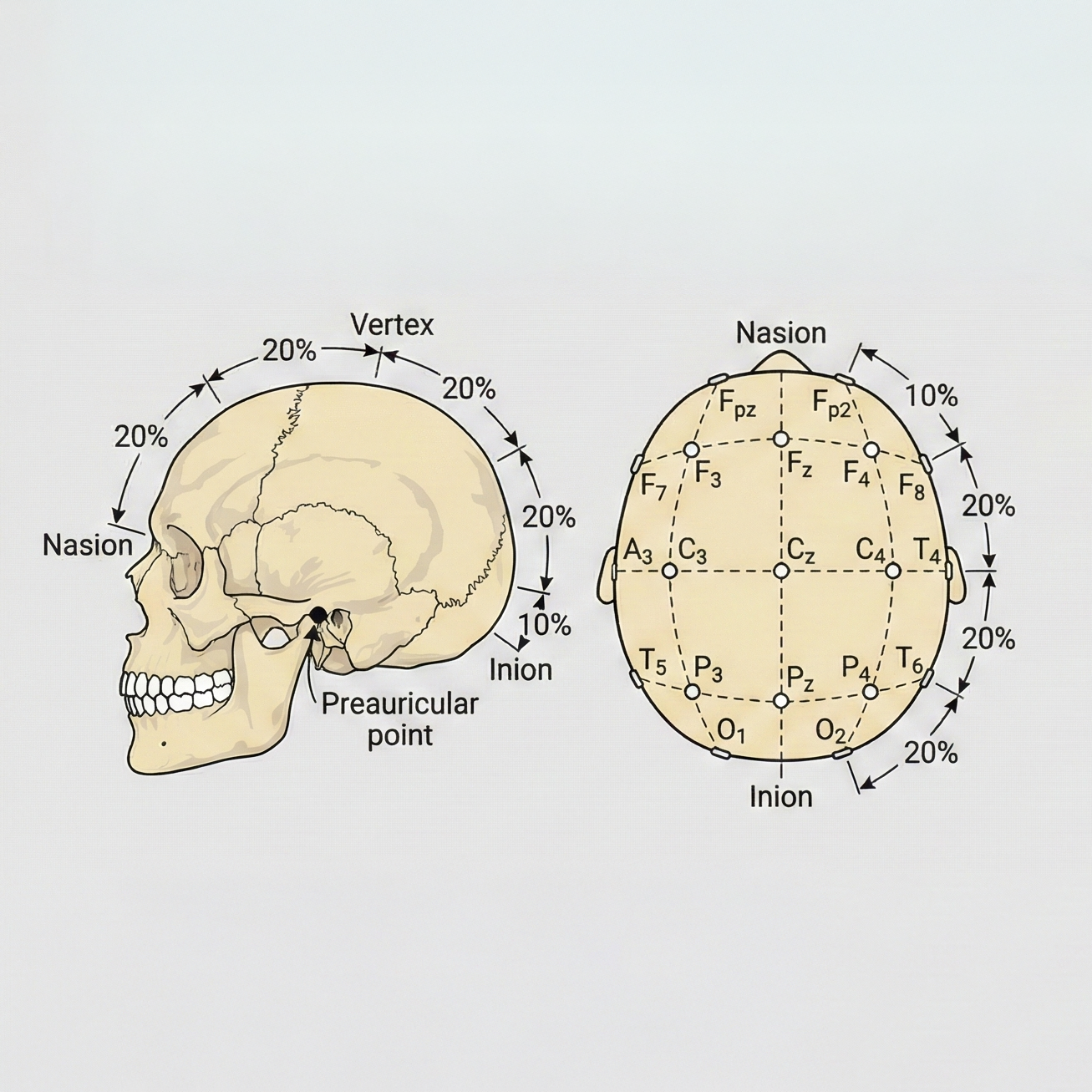
Skull Landmarks and Measurements
(10-20 System)
-

Standard 10-20 System
Top View
-

Extended 10-10 System
Top View
-

Color-Coded Functional Areas
10-20/10-10 System


Shop TheBrainDriver© tDCS Devices
-
 TheBrainDriver.com - tDCS Device v2.1. Ships Worldwide Daily. Safety Features Built-inTheBrainDriver.com - tDCS Device v2.1. Ships Worldwide Daily. Safety Features Built-in
- Regular price
-
$ 139.97 - Regular price
-
$ 199.99 - Sale price
-
$ 139.97
Quick view
-
 TheBrainDriver tDCS Device v2.1 + 6 Extra Pairs of Sponges. Ships Worldwide Daily. Safety Features Built-inTheBrainDriver tDCS Device v2.1 + 6 Extra Pairs of Sponges. Ships Worldwide Daily. Safety Features Built-in
- Regular price
-
$ 149.97 - Regular price
-
$ 217.99 - Sale price
-
$ 149.97
Quick view
-
 TheBrainDriver.com Unit. Renewed tDCS. tDCS Device v2.1. Ships Worldwide Daily. Safety Features Built-inTheBrainDriver.com Unit. Renewed tDCS. tDCS Device v2.1. Ships Worldwide Daily. Safety Features Built-in
- Regular price
-
$ 109.97 - Regular price
-
$ 199.99 - Sale price
-
$ 109.97
Quick view


